
In the design world, premium quality is often a byproduct of accumulated micro-decisions. One such decision—frequently ignored in rapid development cycles—is the logic behind nested corners. At unlimited.studio, we treat this as part of our design-engineering practice: the kind of detail that separates production-ready interfaces from rushed ones.
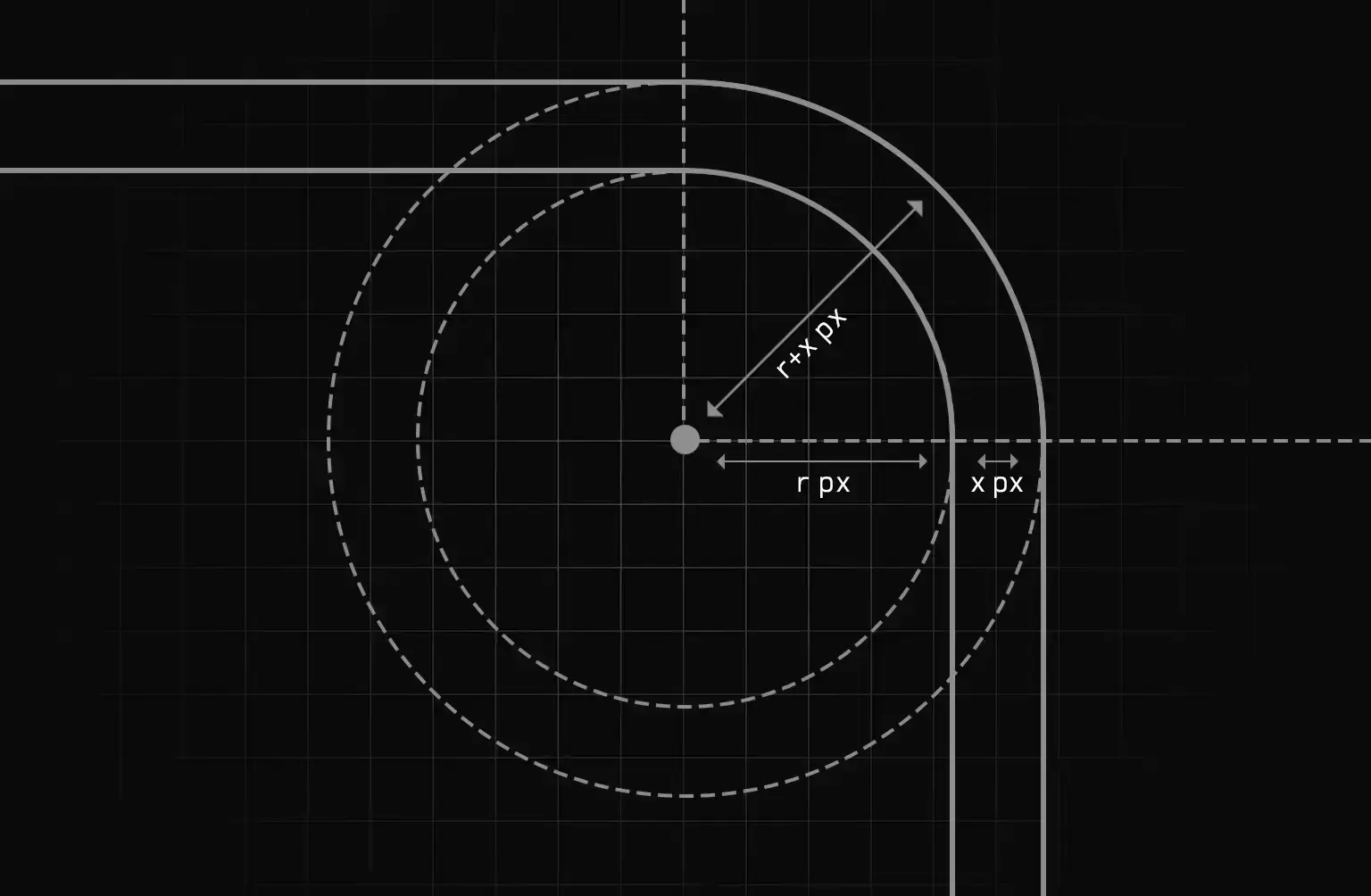
When UI elements are layered, simply applying the same border-radius to every layer creates a disjointed look. To achieve a truly high-end finish, we maintain geometric continuity by ensuring both curves share the same center point. This is the essence of concentricity.
Why Does It Matter?
Our visual system is hardcoded to seek out geometric continuity. When curvature isn't mathematically aligned, it creates subtle 'visual friction'—the eye snags on the irregularity. When the radii aren't balanced, the corners can look either too 'sharp' or too 'crowded' relative to the outer edge.
Maintaining concentricity ensures that the space between the nested element and its container remains visually consistent throughout the entire turn of the corner.
The Engineering Logic
While design tools often handle this automatically through intelligent offsets, implementing it in code requires a predictable, architectural constraint. It's a simple relationship between radius and spacing:
outer radius = inner radius + paddingBy following this rule, we ensure that the gap (padding) between the two elements is exactly the same at the apex of the curve as it is on the straight edges.
Implementation in CSS
One of the reasons we focus on this level of detail at unlimited.studio is being able to codify these patterns so they scale across client projects. Using CSS variables makes this trivial to manage:
.card {
    --inner-radius: 12px;
    --gap: 16px;

    padding: var(--gap);
    border-radius: calc(var(--inner-radius) + var(--gap));
}

.card-content {
    border-radius: var(--inner-radius);
}
This approach is particularly useful in design systems where you want to maintain consistency as components scale or padding values change.
From Physical to Digital
This concept isn't new or unique to the web. It's a fundamental principle in industrial design. If you look at high-end physical products—like the chassis of a MacBook or the casing of a Leica camera—you'll see concentric offsets everywhere. Translating this level of craftsmanship to digital interfaces sets apart exceptional digital products from ordinary ones.
Final Thoughts
It's a tiny detail, but we believe that building interfaces that feel 'alive' and premium requires this level of attention to detail. When users say an interface feels 'smooth' or 'well-built', they might not be able to point to the concentric border radius, but they're definitely feeling the effects of it.
At unlimited.studio, it's the kind of craft we bring to every project—caring enough to do it right, even when most people won't consciously notice.